






ELIXHER Chats With Queer Beauty Queen Djuan Trent


Interview By Helen McDonald
A few weeks ago we told you that Djuan Trent, former Miss Kentucky 2010, took to her blog to speak out about being queer. The 27-year-old pageant titleholder from Columbus, Georgia came out on her blog, Life in 27, in late February to identify publicly with the LGBTQ community and to show how recent developments in the nation, like Kentucky’s recent ruling to recognize out-of-state same-sex marriages, affect her. Djuan sat down with us to tell us more about her experiences as a queer Black woman.

Djuan Trent and ELIXHER’s Helen McDonald (right) Skype date!
ELIXHER: Congrats for coming out in your blog last month. It was pretty unique for you to identify as “queer.” Would you mind explaining what “queer” means for you, or how you came into using that label?
DJUAN: What got me to first use the term queer was actually [the web series] The Peculiar Kind. They used it a lot and they talked about it a lot. And I was just like, “Wow, I really like this and I didn’t know it was a thing so I’m going to use it now.” I like it because, from what I understand, it basically means not heteronormative. And, I think one of the things that I found amongst me and some of my friends is that I have a lot of friends who identify as lesbian but who are also like, “That doesn’t mean that if I never met the right guy that I wouldn’t date them,” even though they are very aware that their true preference — what they are most attracted to — is a woman. And I feel the same way. I like “queer” because it’s one of those things that kinda gives you the freedom to not have to put yourself in a box as lesbian. In certain conversations, I have identified myself as gay or lesbian. I don’t have a problem with ["gay/lesbian"] — but, I chose to use the term “queer” just because I think that it’s a term that’s not used enough. I think that a lot of people are not aware that it’s a thing, and I think that in the Southeast it’s still one of those things that’s kinda taboo, like you just don’t use that word. Also, I just like it.
ELIXHER: And that’s totally fair. In saying there’s still kind of taboo around [the word queer], do you feel like you’re able to reclaim it as well? Do you feel like you’re also making a statement like “We [in the Southeast] are not backwards like everyone portrays us as”?
DJUAN: Yeah, I think I kind of accidentally did that. Like I said before, I really didn’t know it was going to be a thing where people would be like, “Oh my God…” There was a news station in D.C. that was like, “Miss Kentucky has come out as [pause] queer. Now we wanna make it very clear that she has said that. Herself. Those are her words. ‘Queer.’” They just made it very awkward and it doesn’t really have to be that awkward. But I think that me using that word has kind of brought about some awareness for people to know that it is used within the community, and I think that it’s a word that’s okay to be used outside of the community as well. Also, I’ve come to realize that it’s kind of a generational thing. For generations that have come before us, it’s a word that was used for teasing and bullying, and it just wasn’t a word that was used in a positive light. But I feel like for our generation, it’s one of those things we’re open to using, that we’ve reclaimed in a positive way, which I think is cool. After having conversations with people from older generations, they seem to be a little more understanding by saying, “I still don’t like it, but I understand why you use it and that’s fine.”
ELIXHER: You mentioned in your blog post that you struggled to accept yourself, and even prayed to God because you thought He made you “wrong.” How did you come to terms with your sexuality, especially when faith seems to play a big part in your life?
DJUAN: It was one of those things that really was not going away. Every guy that I dated, I’d sit down and have this talk with them and I’d be like, “Ya know, I just want to let you know that in the past I’ve been attracted to women and I think that it was just a phase. I’ve really prayed and that part of my life is done with and it’s not something that you would need to worry about.” And then midway through the relationship they’d be like, “Are you sure you’re not gay?” [Laughs.] It came down to me and my last boyfriend and we actually sat down and had a conversation. He was like, “I don’t think that this was something that was just a phase like you think it was. I think you really need to open yourself up to it.” And I was like, “I think you’re right.” And he and I are still best friends and he’s been the most supportive. He kind of helped me get out of the closet. He kind of helped me to come to terms with myself on that.
ELIXHER: Wow.
DJUAN: I know, that was really interesting. People are always like, “That’s so weird,” but he’s just one of those people that is extremely understanding and knows the way of the world, and is willing to accept life as it comes. So I’m very lucky to have him as my best friend and to have had him be so understanding at that point.
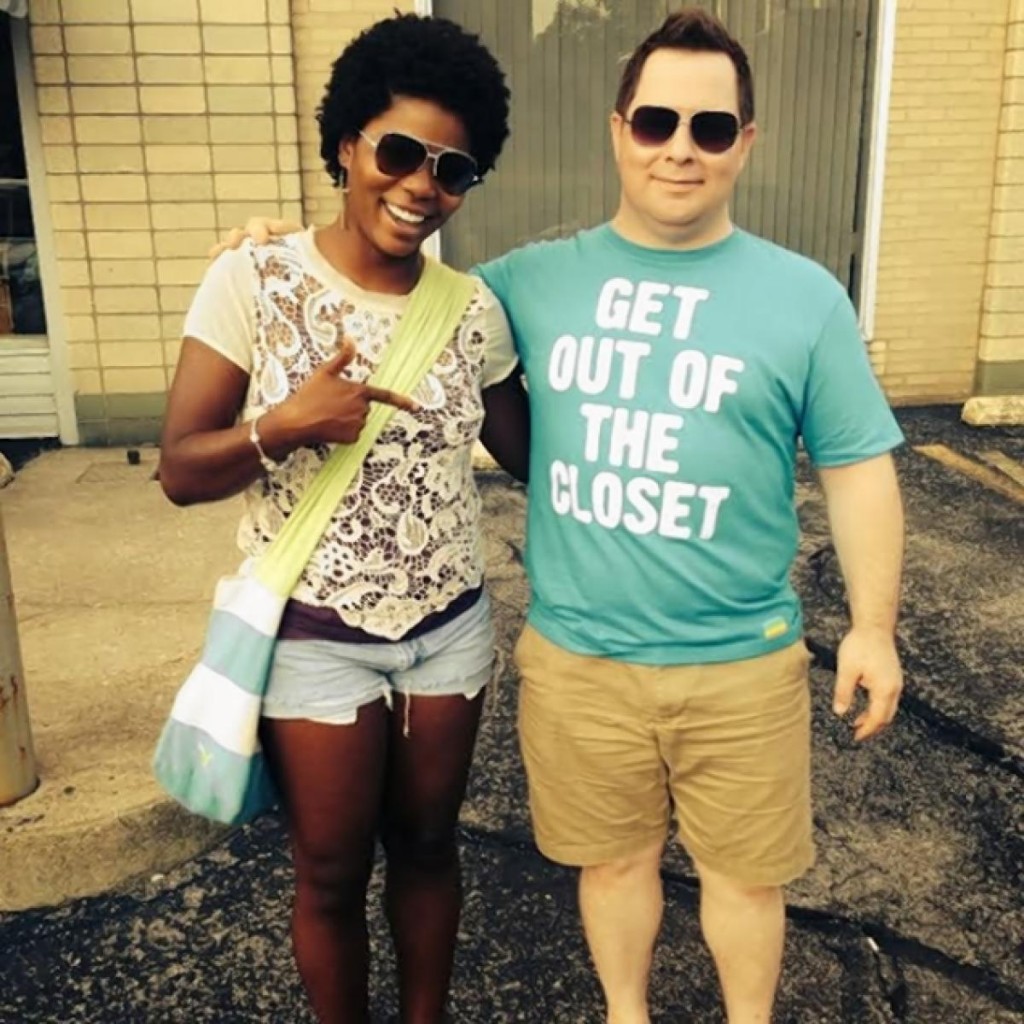 ELIXHER: That’s really cool that he was such a great support system. Do you have other support systems there, like a chosen family, that’s helped you get through understanding your sexuality?
DJUAN: So Mike was the first person that I actually had the conversation with. Pauli [Mayfield], she was Miss Iowa with me while I was Miss Kentucky and we became best friends in a matter of two minutes. When I was opening myself up to this, I talked to her about it and she was like, “Well, I love you and I’ll support you 100%.” So she’s been there with me from the beginning as well. I acquired some friends from the first young woman that I actually dated and they’ve been very supportive with me. There’s one who has a son who is gay, so I talked to her a lot about what it was like for her, when I was trying to figure out how I wanted to come out to my mom. There were some other friends from that group that were very supportive and [understood] that I was comfortable with myself, but not comfortable enough to just be out.
I think that one of the most dangerous things you can do is to push or pull someone out of the closet. We stay in the closet because it’s a safe space and once you get to that space [where you're] comfortable enough with yourself, eventually you do get tired of being in the closet. But that’s a personal process that you have to do yourself. It’s not something that you do for someone and it’s definitely not anyone’s place to remove you from that space until you’re comfortable enough with it. So, I’ve had lots of friends who were supportive in that way.
My friends since the second grade…they were not surprised. They were like, “We always knew there was something different about you.” My mother and my brother have been very supportive also. With my brother, it ended up being a series of four or five texts. He sent me a text and was like, “Hey, can I ask you a question?” And I just replied, “The answer is yes, yes, yes, and yes.” And he was like, “Ok, glad we had this conversation lol.” And that was it. So it’s been interesting, but the support that I’ve had around me has definitely made it a much easier thing to do and I’m very thankful for that because I know that there are a lot of people, especially young people that have reached out to me here in Kentucky, who don’t have that support. I don’t take it for granted at all.
ELIXHER: You mentioned in your blog post having to come out to your mom three times. What motivated those coming out moments to your family? You said that your brother accepts you and your mom accepts you — does the majority of your biological family accept you?
DJUAN: Yeah, I’ve gotten phone calls, and emails, and even Facebook messages from my family who have been like, “You’ve always been so brave and been such an inspiration and we love you no matter what and we know that this doesn’t make you any different of a person,” and just offering words of support. With my mom, in the fourth grade I came out… Okay, so it’s weird because I don’t even know how I knew what gay was in the fourth grade and I lived such a sheltered life. It’s not like people were just coming out left and right on TV. I was just like, “Mom, I’m gay,” and she said, “What? You don’t even know what that is.” I was like, “Why can’t you just accept me?!” and she was like, “Girl… if you don’t get back in your room…” [Laughs.]
The second time [I came out to my mom] was when I was in college and there was a young woman that I had been spending a lot of time with. I had been like, “I’m going to accept you but I’m just gonna pray because I know the Lord will deliver you from this kind of thing… but maybe I kind of like you. But I don’t, because this is wrong.” So then I decided to ask my mom about it. I tried to ask her through a series of questions. I was like, “Ya know, I’ve heard a lot of people say that everyone experiments in college… Did you ever experiment? Did you ever have feelings for a girl…? Did you ever want to kiss one or something…?” [Laughs.] And my mom was like, “This — all of this that you’re talking about – is not of God. And you need to pray because that is a demon.” And I was like, “Oh, you’re right. Nevermind. Yeah, I’m gonna just pray that away.”
This last time [I came out to my mom] was a little over a year ago. It was right after New Year’s. I had just gotten back from D.C. and I was telling her about this couple I had gone to visit who had just adopted the cutest little girl and they had a little boy on the way and she asked, “Why did they adopt?” I told her, “Because they’re gay,” and she was like “Are all your friends gay? Is that all you know — gay people? Is there something you need to tell me?” I was like, “Is there something you need to ask me?” She gave me the mom look and I [told her] I’m attracted to women. And she already knew that so I was like, “Okay, what’s your question? Why are we having this conversation?” And she just proceeded to say that she knew that I was attracted to women but she thought that it was a phase and something that I was over because I continued to date men. I was like, “Well I continued to date men because you told me to pray it away and I thought that it was a phase, but now I know that it’s not.” And then we had the rest of the conversation from there, like her asking questions and wanting to better understand. It has been a process for her as well.
I think that’s one thing people don’t take into consideration as well. Coming out is not just a process for an individual but it’s a process for their families, their friends, and the people close to them — but I think mostly for the parent. Not because they think this is something that all of a sudden changes you, but the LGBTQ community is something that the world is progressively accepting. It’s not something that has been normalized. [A parent] has built this fairy tale in their head that you’re gonna get married and have a husband and you’re gonna have all these kids… They have to realize that maybe you’re gonna do all those things, but maybe there isn’t gonna be a husband; maybe there’s gonna be a wife. Maybe [the parent] will have to deal with all of their friends who are like “Why is your daughter gay and how did this happen?” I think that as [my mom] sees that the world is more accepting of [queerness], it’s become easier for her to be accepting of it and for her to understand. When I’ve had relationships, or had a young lady in my life, she will try to get acquainted with them the same way she would’ve done if I had a boyfriend. It’s been interesting to see her come around in that way. I’m proud of her and happy that she is learning how to accept it.
 ELIXHER: A line in your post that really resonated with me is that “once you decide to come out to the public, it is a never-ending process.” I’m not sure if you identify as femme but I think that especially for femme women or women read as feminine, this coming out process is a daily (sometimes hourly) thing. Do you ever feel frustrated with having to defend your queerness like that? If so, how do you deal with those feelings of frustration?
DJUAN: I can even admit to going through a little phase during my journey of coming out where I thought maybe I need to look gay. Maybe that’ll make it easier. I think that feminine queer women do have a little bit more to combat as far as people’s perception of them because you don’t necessarily “look” gay. I hate to hear the line, “Oh she’s too pretty to be gay.” It’s wrong. That makes no sense. I think people’s perception is that if you like women then there must be some part of you that wants to be a man. There’s also the flip side where I love androgyny. For me, I wonder if it is a pressure or preference sometimes to remain feminine to prove a point or [if I] remain feminine because that’s what I want to do.
ELIXHER: Yeah, I definitely went through a phase where I was like, “I guess that means I need to wear plaid now. That sounds right…”
DJUAN: Right! [Laughs.]
ELIXHER: How’s life in Kentucky, in general, since coming out?
DJUAN: It’s cool. There’ve been a lot of people who have expressed their main concern being for my safety. There’s a part of me that wants to be defensive and ask, “Why would you say that?” But there’s the other part that’s knows realistically I am a Black, queer woman so in some people’s eyes, that would be three strikes against me already. Kentucky is becoming more progressive but it’s traditionally known as a more conservative state. So I can understand people’s concerns for my safety. But I really don’t think that [my queerness has been] held against me or anything. It’s something that opens people’s eyes. I’ve had people who, even at my job, have been like, “Well, I really don’t understand it but I love you and I accept you,” and that’s just fine with me. I’m not here to speak for all of the queer world to make [others] understand. I also understand that sometimes there’s that generational gap, and if someone says they don’t understand but they accept you, well that’s almost as good as acceptance in general. And at least it’s not so much about “those gay people,” it’s about someone that [they] actually know.
ELIXHER: I think that in a lot of LGBTQ circles, the biggest emphasis is placed on marriage equality — which is important for a lot of people— but there are other issues more pressing for queer Black women. What are some issues with respect to queer Black women and queer women of color that you hope LGBTQ communities will address more as the movement pushes forward in its anti-oppression work?
DJUAN: I was having a conversation with someone the other day, and we were talking about how misrepresented the LGBTQ community is. Even here in Kentucky, our Lexington Fairness Board is comprised of all white, middle-aged, middle-class men. That doesn’t really work. So I’ve reached out to them to get more involved, but I think that we [queer Black women] are definitely underrepresented. I think also when we are represented — [as] someone pointed out to me — a lot of times when you see an African American woman who is supposed to represent the queer community, it’s always someone who’s more of a stud, or a dom, or masculine of center, whatever you want to call it. So that’s what people think of when they think of a gay, Black woman. Even though there are other queer Black women in the public eye, the one that becomes more glorified is the one who represents a specific aspect of queer [life]. I hope to see us better represented.
About the Author:
Helen McDonald is a 20-something college student living off of bad cooking, social justice and a lil snark. She also discusses the intersections of race, gender, and sexuality on her personal blog revolutionaryrainbows.tumblr.com.
Previous Story
WATCH: Janet Mock on Talks at Google
Next Story
This is the most recent story.





Recent Comments
- Queering Black Feminism (2)
 { my thoughts on a few of your questions!
  Where is the place of LGBTQ folk of color in relation to issues in Black politics?... } – Mar 26, 7:51 PM
 { awesome informative piece!! } – Mar 25, 1:36 PM
- UPDATE: Father of Victim Arrested for Tampering with Evidence in Texas Lesbian Couple Case (4)
 { Emily, we're monitoring this story daily and will post any updates as soon as we're aware of further developments. } – Mar 26, 8:58 AM
 { DOES ANYONE HAVE ANY UPDATES? AS FAR AS I HAVE READ, THIS GUY WAS ARRESTED FOR TAMPERING WITH EVIDENCE. IT HAS BEEN A LONG TIME... } – Mar 25, 8:14 PM
- Grief As A Siren: On Life, Faith & Not Looking Back After Divorce (4)
 { Thank you so much for sharing } – Mar 25, 6:09 AM
- Older »




Submit a Comment