





Exploring the Fears of Closeness within the Black Queer Family Unit

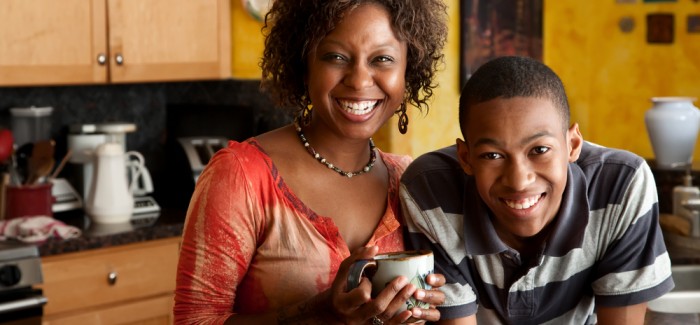


For most womyn with children, their partner’s ability to connect with their son(s) or daughter(s) greatly affects the relationship. More often than not, if the partner is unable to maintain a relationship with the child, the relationship comes to an abrupt end despite the love shared between the two adults. But what happens when neither party is willing to let go? Does one ignore the needs of their family to feed their own personal desires? Or do they take the time to investigate the root cause of the issue?
When one chooses to engage in a relationship with someone who has kids, it is not just the parent that they must win over. In order to achieve a sense of family, all persons involved, including the children, must feel a sense of connection that extends beyond the word itself. In a perfect world, one may see family as some well-oiled machine that runs in a cohesive manner without fault. The truth is that a true family is far from perfect but its members love one another enough to persevere.
Many years ago, I was in a relationship with someone whom I had every intention of building a family with. After a very short time, I began to notice that when it came to interacting with my daughter, they fell short in the bonding department. This immediately raised red flags for me because I believed that family meant that everyone connected in some way. The relationship did not last due to a plethora of issues; however, the one problem that drove me to making the decision to leave was the fact that my former partner was unable to have a relationship with my daughter.
Years later, my ex and I talked about why she had a hard time developing this bond. The reason stemmed from the years of sexual abuse she had endured at the hands of a family member. She was told that an individual who had been molested would go on to molest, and although she had never considered touching a child inappropriately, she feared the possibility all the same and chose to stay away from all children. It also didn’t help that the child of her previous ex had accused her of molestation to thwart punishment. I knew of the child abuse that she had been a victim to but I never considered that one had to do with the other. Over the years I have heard this similar story repeated amongst others and I began to wonder how prevalent this issue is amongst queer womyn of color.
ELIXHER columnist Dr. Bukky Kolawole, a licensed psychologist who specializes in couples counseling, explains that molestation can break down the trust one has in humanity, which could lead to a hyper-vigilance towards any relationship.
Dr. Bukky goes on to say, “The sense of closeness can be tricky to navigate and touch, after a history of trauma, can be overwhelming to the abused person. The individual experience determines how one can interact with others.”
While speaking with a survivor of sexual abuse she states that it is easier for her to get closer to the parent than the child because the way trust is established varies. For her, trust is established immediately with the one she is dating while it takes longer to establish this trust with a child.
One woman shared: “It is not that I don’t love or trust my partner’s child, it is just taking me longer to do so, if that makes sense…because I was molested it is hard for me to allow a child to hug me and my partner’s child loves to hug. I am getting better at it; it is just hard for me right now.”
While one’s first instinct may be to help the sexual abuse survivor in an effort to “correct” what the other deems as a problem, Dr. Bukky insists that the parent of the child not accuse the partner of having an issue that requires professional help. She concludes that the best way to approach the issue is to create a safe space for the person to discuss their feelings void of accusations and voicing a need for treatment.
“The victim is the one who names their trauma,” Dr. Bukky elaborates. “When you enter the conversation with a person and you say they need help, it appears as if you are coming from a judgmental place.”
So how do you begin to approach the perceived issue without alienating your partner?
1. Approach - Share the behavior you have observed as just that-an observation and not an accusation.
2. Listen - Dispel your preconceived notions. Allow your partner to freely vent without interruption. This will help them to feel comfortable.
3. Create a blame-free environment - Do not immediately accuse them of having a “problem” that needs professional help. Allow them to open up and share their views. If they say that they have dealt with the issue, find it how they have dealt with it.
Dr. Bukky also suggests that those who know that their partner has been sexually abused and want a better understanding read Allies in Healing: When the Person You Love Was Sexually Abused as a Child by Laura Davis.
It is also important to remember that past abuse may not always be the cause of issues with closeness and if your partner has been abused, they may not have worked through it. This is why how you approach the situation is very important.
Family among queer womyn of color comes in different forms. However, the essence of it does not waver. Whether you are inviting your partner into your own family complete with children and a dog or creating one with them, it is important to understand that in doing so you will be a support to each other. A unit is only as strong as its weakest link and if there is a kink, it is best to acknowledge it than to let it fester.
If you have experienced a similar situation, we would love to hear from you and your stories of perseverance.
- Spoken Pandora
Spoken Pandora considers herself a gypsy that has traveled worlds through the literature she writes. Currently she resides in North Carolina with her daughter and partner. When she is not writing, she publicly speaks at LGBTQ events on sexual related topics. Her work can be found on her website.


Recent Comments
- A Love Letter to Studs and Bois (45)
 { Thank you for such a touching and beautifully written/spoken letter, we need to start embracing each other instead for hurting each other, we all are... } – Mar 07, 2:33 PM
 { SUCH KIND WORDS-A love Letter to a Stud. I NEEDED TO READ THAT. IT NOT ONLY MADE ME FEEL RECOGNIZED, BUT ALSO MADE ME TAKE... } – Mar 07, 2:54 AM
- QWoC Chronicles: Three Countries, Two Lives, One Love (10)
 { That was beautiful. My wife and I are expats in Korea. Thank you for sharing your story. We were thinking about going back to the... } – Mar 07, 7:27 AM
 { Great article. I love learning more about you two! I'm in awe of what The Roses are able to do.
  can't wait to read... } – Mar 06, 10:54 AM
- 25 Beautiful Photos Of Black Queer Women That'll Make You Believe In Love Again (63)
 { Good Evening, Everyone. Take it from a silver fox. " Keep your dream big." Do you think when I was a little black girl growing... } – Mar 06, 11:42 PM
- Older »






Submit a Comment