






Party People: Four Promoters Cater to the Black Queer Community

Depending on where you reside, your options for getting an after-work cocktail or your dance on over the weekend might vary. ELIXHER caught up with four promoters from major cities around the country to get their thoughts on the queer social scene—the good, the bad, and everything in between. While parties for ladies who love ladies are not limitless, these women are making moves to ensure that Black lesbian and bi women have safe spaces to gather, socialize and let loose.
Lush fros. African drums. Denim cut-offs. Sticky bodies. It’s a typical night at SWEAT!, a queer 21+ party in Brooklyn, N.Y.
“The vibe is all about the dance,” says party promoter Khane Kutzwell. “You’ll rarely see wallflowers posted up at SWEAT! and the people who attend know they’re going to get wet and dress appropriately,” she explains laughing.
The event, open to all queer folks of all gender expressions and all orientations, attracts a diverse crowd of women and men from across the entire LGBTQ spectrum. The people change just about every party. Sometimes there are a lot of men; other times there are a lot of trans folks or even a lot of one particular race.
“SWEAT! is for everyone who wants to get away from being boxed,” Khane Kutzwell adds.

Photo: SWEAT!
On the other side of town in Manhattan, you’ll find a crowd of beautiful brown women in sky-high stilettos and daring minis with sleek strands. “I like to keep my following exclusive and sophisticated,” says Cassie Duprey, C.E.O of Dreamgyrls Entertainment. Although exclusive, the parties (generally 21 and over) tend to draw women from different backgrounds.
“Every event I host isn’t the same,” she explains. “It all depends on the venue and the night of the week.” What you can expect is a well-dressed group of ladies (Duprey enforces a dress code) getting down to everything from hip hop to dancehall to Top 40.
“There is a definite division as to the type of Black women that attend certain events,” Khane Kutzwell admits. “I think that will always be the case.” But like Khane Kutzwell, Duprey doesn’t think this is necessarily a bad thing.
“Our community is most definitely segregated when it comes to events. However, that’s because we now have so many options,” Duprey explains.
Avanti Fernandez, co-founder of Premiere Entertainment, an event planning group that hosts “contemporary, chic, and eclectic” events for the LGBT community in Washington, D.C., has a different take.
“I don’t think the D.C. lesbian scene is divided,” Fernandez explains. “If anything, we’re more united [here].” According to Fernandez, the Black lesbian and bisexual women in D.C. all know each other and party together.
Since their inception in February 2010, Premiere has thrown monthly parties—their most popular event being their rave. The rave includes 5 DJs, 2 rooms, and genres ranging from hip-hop and R&B to dubstep, moombahton, and electro. The diverse playlist draws an eclectic group of “music heads,” ranging from 18 to 35 years old dressed comfortably in everything from button ups and fitteds to cropped tops and fedoras. Their last rave brought out a crowd of more than 800 gay, lesbian and trans men and women.
“People come out to wherever there’s a good party,” Fernandez adds.
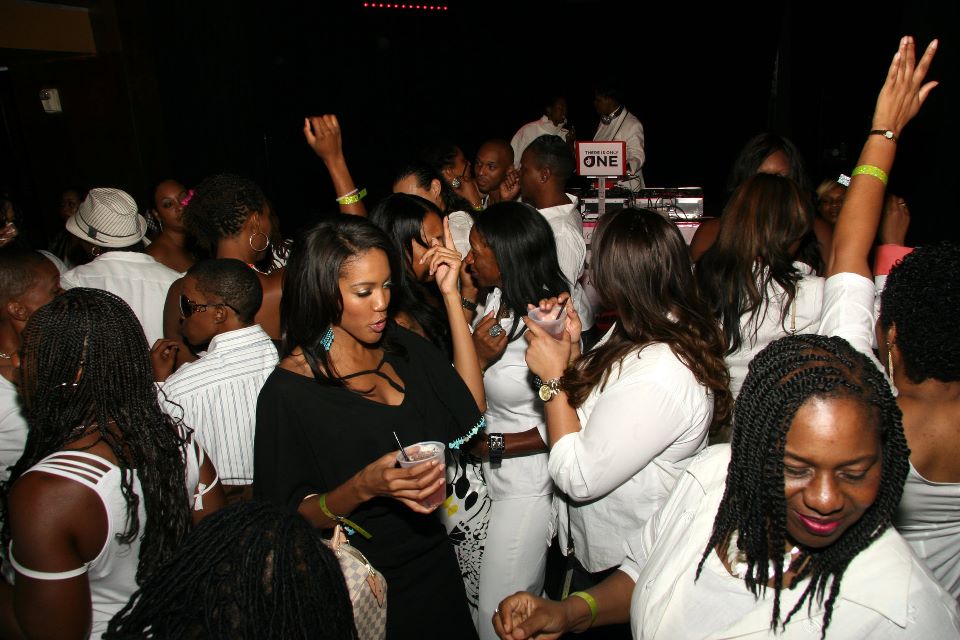
Photo: Chocolate & Wine
On the West coast, Mignon Moore promotes Chocolate & Wine Upscale Events—the largest event for Black lesbians in Southern California—with her partner, Elaine Harley. They host a monthly party, and have also organized wine tastings, single’s events, brunches, events in Palm Springs for Dinah Shore Weekend and other activities to promote a sense of community for women of color. The events tend to attract artists and professional women in their 30s and 40s.
“There is such an invisibility of Black lesbian women in the Los Angeles gay world,” Moore explains. “And women not in their 20s are even less visible. They really form a connection with what we do.”
Moore has found that the older crowd likes the sophisticated yet friendly vibe. Women who want to have a space that’s just as chic as their White counterparts, according to Moore, will commute to a Chocolate & Wine affair.
What also draws more mature women to their functions is the music. In Los Angeles, DJs mostly play West Coast and Southern rap. At Chocolate & Wine parties they make it a point to play a lot of R&B, soul and old school music and throw in some House, reggae and Latin beats.
While there is no enforced dress code, attendees do dress the part in heels, cocktail dresses, blazers and crisp collared shirts. Moore attributes this to the upscale venues and the vibe of their events (think lofts with a laidback lounge feel).
“People have a high expectation [for our events] so they conform without us being restrictive. We don’t like telling people what to do.”
When it comes to class divisions, Moore thinks there’s more than what meets the eye. “Gay spaces are some of the most class integrated spaces because people are coming together based on this one identity status—being gay—and that allows for a wider range of class in a room than you’d find in other spaces.”
One thing is for certain, the Black queer social scene has come a long way. Women now have options they had only hoped for in past years.
“The promoters that we have in our community have done an incredible job at targeting every type of Black lesbian or bisexual that’s interested in socializing with others just like them,” Cassie Duprey from N.Y.C’s Dreamgyrls Entertainment says.
Ten years ago, Duprey recalls, there were maybe two events a week for queer women of color in New York City. But an abundance of options may not be the case for all Black queer women.
“The party pickings are slimmer for bisexual women and that is sad,” SWEAT!’s Khane Kutzwell points out. The prevalence of biphobia and stigma against bisexual women can make it challenging for some of them to find safe spaces, she notes.
Without a doubt, we still have some strides to make. In addition to the lack of bi-inclusive events, there are few Black- and queer-owned establishments. But whether we’re making moves on a dance floor, a community space or in our homes, Black lesbian and bi women are certainly serving our community in unprecedented ways.
What’s the social scene like in your city?
-
Thannks for an interesting, well-written article about Black lesbian life! I will definitely share with others and look forward to reading your archives as well as future stories by us about us for us!
Submit a Comment


-
3rd Annual *Word*Rock*&Sword: A Festival Exploration of Women’s Lives
September 13, 2013
September 13, 2013
InspiHERed By: Marsha Philitas
September 11, 2013


Recent Comments
- Men And Women Disrupt Gender Norms In Striking Photography Series (1)
 { Love this post. This is a project I've been wanting to do for some time now, but have been stretched too thin for time to... } – Sep 12, 8:18 AM
- WNBA President Condemns Player Sophia Young's Anti-Gay Tweet (2)
 { What amazes me is that before jumping on the train to bigot-ville she should have at least taken the time to understand exactly what was... } – Sep 10, 12:57 AM
 { I'm not surprised. I'm tired of the homophobia in the black community. It only helps weakens us. If we embrace the black LGBT, it is... } – Sep 02, 12:35 PM
- Actress Raven Symone Radiates Beside Out Model AzMarie (1)
 { They both look amazing. continued happiness to them both. } – Sep 09, 7:18 PM
- Co-Parenting: When the Relationship is Over (6)
 { I am going through this as I type... My ex and I were in a 7 year relationship broke up about 3 years ago she... } – Sep 07, 12:49 PM
- Older »



Comments